The goal of causalXtreme is to provide an interface to perform causal discovery in linear structural equation models (SEM) with heavy-tailed noise. For more details see Gnecco et al. (2021, https://arxiv.org/abs/1908.05097).
Installation
You can install the development version from GitHub with:
# install.packages("devtools")
devtools::install_github("nicolagnecco/causalXtreme")
Example
Let us generate 500 observations from a SEM of two Student-t variables, and , with 1.5 degrees of freedom (i.e., heavy-tailed). When the function simulate_data is called with the default values, it returns a list containing:
- the simulated
datasetrepresented as a matrix of size . Here, is the number of observations and is the number of variables, - the underlying directed acyclic graph (DAG) represented as an adjacency matrix
dagof size .
library(causalXtreme)

# basic example code
set.seed(1)
sem <- simulate_data(n = 500, p = 2, prob_connect = 0.5,
                     distr = "student_t", tail_index = 1.5)
At this point, we can look at the randomly simulated DAG.
sem$dag
#>      [,1] [,2]
#> [1,]    0    1
#> [2,]    0    0
We interpret the adjacency matrix as follows. Loosely speaking, we say that variable causes variable if the entry of the adjacency matrix is equal to 1. We see that the first variable causes the second variable , since the entry of the matrix sem$dag is equal to 1. We can plot the simulated dataset.
plot(sem$dataset, pch = 20,
     xlab = "X1", ylab = "X2")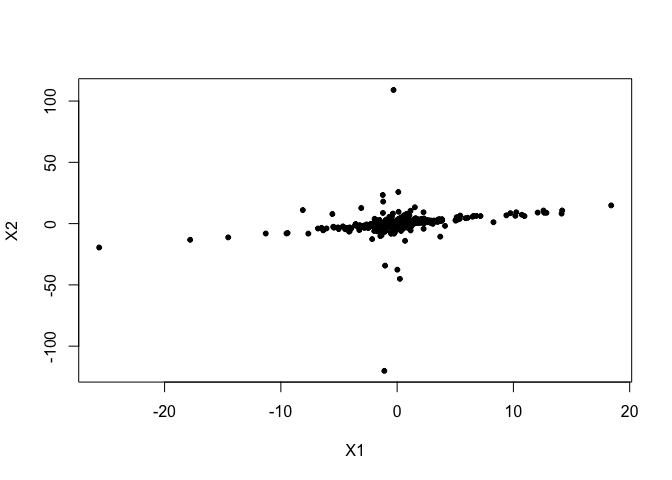
At this point, we can estimate the causal direction between and by computing the causal tail coefficients and (see Gnecco et al. 2021, Definition 1).
X1 <- sem$dataset[, 1]
X2 <- sem$dataset[, 2]

# gamma_12
causal_tail_coeff(X1, X2)
#> [1] 0.9523333

# gamma_21
causal_tail_coeff(X2, X1)
#> [1] 0.4816667
We see that the coefficient (entry of the matrix) and (entry of the matrix). This is evidence for a causal relationship from to .
We can also run the extremal ancestral search (EASE) algorithm, based on the causal tail coefficients (see Gnecco et al. 2021, sec. 3.1). The algorithm estimates from the data a causal order of the DAG.
ease(dat = sem$dataset)
#> [1] 1 2
In this case, we can see that the estimated causal order is correct, since (the cause) is placed before (the effect).


